Where to Put a Cat Tree: 7 Best Places in Your Home
Choosing where to put a cat tree can make a big difference in how often your cat actually uses it. The best locations give cats a combination of good views, vertical territory, easy access, and proximity to the people and spaces they already enjoy.
In this guide, we'll show you the 7 best places to put a cat tree, where you shouldn't put one, and how to choose the right location based on your cat, your home, and the size of your tree.
Quick Answer:
For most cats, the best place to put a cat tree is near a window in a room where your family spends time. Look for a location that gives your cat a good view, easy access, and enough surrounding space to climb and jump safely.
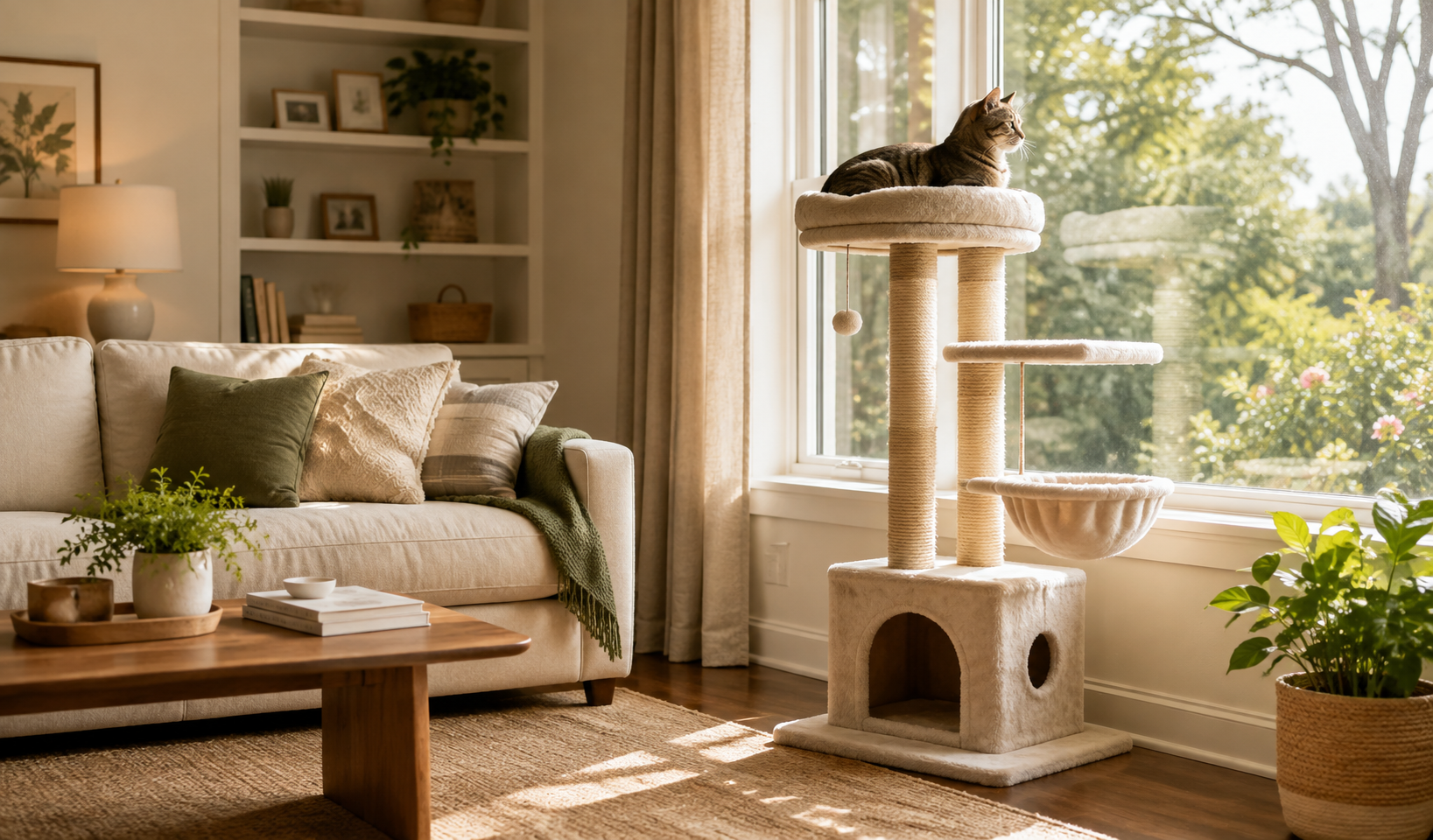
7 Best Places to Put a Cat Tree
The best location for a cat tree is somewhere your cat already enjoys spending time. Look for areas that offer a combination of good views, family activity, comfortable resting spots, and enough room to climb safely.
1. Beside a Window
For most cats, beside a window is one of the best places to put a cat tree. It gives your cat an elevated spot to watch birds, squirrels, people, and outdoor activity while enjoying natural sunlight.
Window placement can be especially valuable for indoor cats because it turns the cat tree into both a resting spot and a source of everyday enrichment.
Why it works:
- Provides an interesting outdoor view
- Encourages your cat to use the tree regularly
- Creates a sunny spot for naps
- Adds mental stimulation for indoor cats
Placement tip: Position the tree close enough for your cat to enjoy the view, but keep platforms safely away from blind cords, curtains, and anything your cat could become tangled in.
2. In the Living Room
The living room is an excellent place for a cat tree because many cats prefer being near their people rather than tucked away in an unused room.
A well-positioned cat tree lets your cat observe household activity from above while still having their own dedicated space to climb, scratch, nap, or retreat.
Why it works:
- Keeps your cat close to the family
- Provides a comfortable observation spot
- Encourages regular use throughout the day
- Gives your cat their own territory in a shared room
Best for: Social cats, multi-cat households, and cats that frequently follow their owners from room to room.
3. In a Quiet Bedroom
Not every cat wants to be in the middle of household activity. For cats that prefer quieter surroundings, a bedroom can be an ideal place for a cat tree.
Bedrooms generally have less foot traffic and can provide a peaceful location for sleeping and lounging. A tree positioned near a bedroom window can offer the added benefit of an outdoor view.
Why it works:
- Provides a quieter resting area
- Works well for shy or easily startled cats
- Creates comfortable vertical territory away from busy rooms
- Can make good use of an otherwise empty bedroom corner
Best for: Shy cats, senior cats, quieter households, and cats that already spend a lot of time in the bedroom.
4. In an Unused Corner
An empty corner can be one of the smartest places to put a cat tree, especially when floor space is limited.
Corner placement allows you to turn space that might otherwise go unused into valuable vertical territory for your cat. A tall, narrow tree can provide several climbing and lounging levels without taking over the room.
Why it works:
- Makes use of otherwise wasted space
- Keeps the tree out of major walkways
- Works especially well with compact or narrow designs
- Adds vertical territory without sacrificing much floor space
Small-space tip: If you're working with a tight room or apartment, our Best Cat Trees for Small Spaces guide can help you choose a tree designed to build up rather than out.
5. Near Your Cat’s Favorite Sleeping Spot
Sometimes the easiest way to get a cat to use a new tree is to place it somewhere they already love spending time.
If your cat regularly naps beside a particular window, couch, bed, or quiet corner, positioning the cat tree nearby can make the new furniture feel like a natural extension of their existing territory.
Why it works:
- Builds on your cat's existing habits
- Makes the tree easier for your cat to discover
- Creates an elevated alternative to their usual sleeping spot
- Can help a new tree feel less unfamiliar
Placement tip: Watch where your cat naturally chooses to sleep and relax for a few days before deciding on a permanent location.
6. Near an Existing Scratching Area
If your cat already scratches in a particular area, that location can be an excellent clue about where to place a cat tree.
Putting a tree with sturdy sisal posts near an existing scratching spot gives your cat an appropriate surface while also providing climbing, lounging, and play opportunities.
Why it works:
- Places the scratching surface where your cat already wants to scratch
- Can help redirect scratching away from furniture
- Combines scratching and climbing in one location
- Makes the cat tree immediately relevant to your cat
Placement tip: If your cat scratches the side of a sofa, don't initially put the cat tree across the room. Place it close to the problem area so the appropriate scratching surface is easy to choose.
7. Along a Stable Wall
A sturdy wall can provide an excellent location for a tall or multi-level cat tree, particularly for cats that enjoy climbing high.
Placing the tree along a wall can help it feel integrated into the room while keeping it away from major traffic areas. More importantly, taller trees should always be positioned where they can remain stable during energetic climbing and jumping.
Why it works:
- Works well for tall cat trees
- Keeps climbing furniture away from busy walkways
- Provides plenty of vertical territory
- Can make a larger tree feel less intrusive in the room
Safety tip: Always follow the manufacturer's assembly and anchoring instructions. If a tall tree includes a wall-anchoring system, use it as directed.
Living Room vs. Bedroom: Where Should You Put a Cat Tree?
Both the living room and bedroom can be great places for a cat tree, but the better choice depends on where your cat naturally spends time and how social they are.
If your cat likes being around the family and watching household activity, the living room is usually the better choice. If your cat prefers quiet naps, privacy, or spends much of the day in your bedroom, bedroom placement may work better.
When the Living Room Is Best
For many cats, the living room is the best place for a cat tree because it combines vertical territory with social interaction. Your cat can climb above the action while still staying close to the people they enjoy.
A living room cat tree works particularly well when positioned near a window, beside a couch, or along a wall where your cat can watch the room without being directly in a busy walkway.
Choose the living room if your cat:
- Follows you around the house
- Enjoys watching people and activity
- Likes being near the family
- Frequently naps in shared living spaces
- Enjoys looking out a living room window
Best placement: Near a window or along the edge of the room where your cat gets a good view without the tree interfering with foot traffic.
When the Bedroom Is Best
A bedroom may be the better location for a cat that prefers quiet, privacy, and uninterrupted resting time.
Because bedrooms generally have less activity than living rooms, they can provide a peaceful place for climbing and sleeping. Bedroom placement can also work especially well if your cat already spends a significant amount of time sleeping on your bed or near a bedroom window.
Choose the bedroom if your cat:
- Prefers quieter areas of the house
- Sleeps in your bedroom frequently
- Is shy or easily startled
- Enjoys long, undisturbed naps
- Has access to a good bedroom window
Best placement: Near a secure window, in an unused corner, or along a wall where the tree won't interfere with doors, closets, or walkways.
So, Which Room Is Better?
For most social cats, the living room has a slight advantage because it keeps the cat tree in an area where both the family and the cat already spend significant time.
But your cat's behavior matters more than the room itself. A perfectly positioned cat tree in a room your cat rarely visits may get far less use than one placed beside their favorite sleeping or viewing spot.
Quick rule: Put the cat tree where your cat already wants to be—not where the tree simply looks best.
Tails & Whiskers Tip
If you're unsure, don't commit to the location immediately. Try the cat tree in one room for several days and watch how often your cat uses it. If it gets little attention, move it to another favorite area before assuming your cat doesn't like the tree.
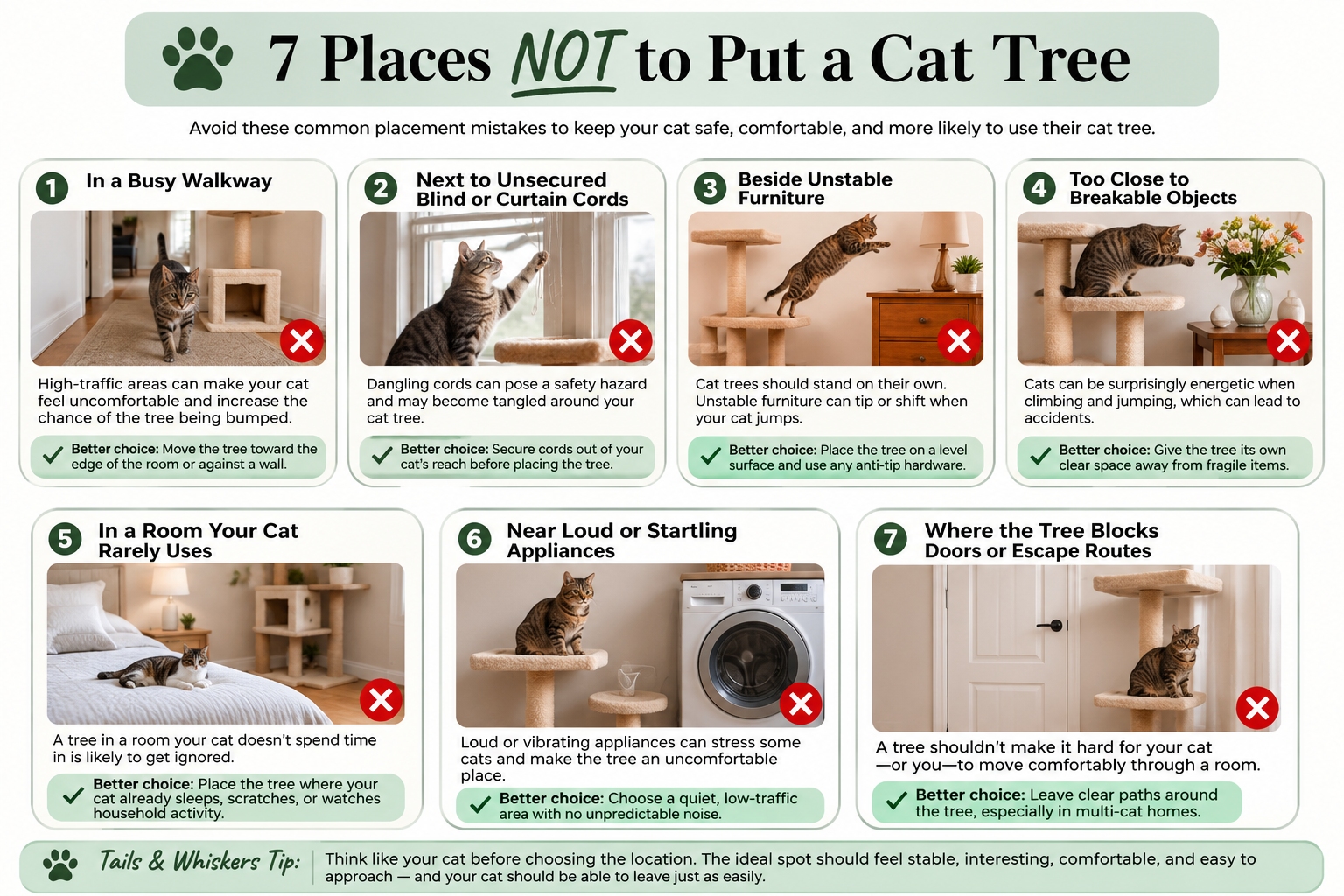
Where NOT to Put a Cat Tree
Choosing the right location matters, but knowing where not to put a cat tree can be just as important. A poorly placed tree may get ignored, create a safety issue, or make your cat feel uncomfortable using it.
Here are the locations we recommend avoiding.
1. In a Busy Walkway
Avoid placing a cat tree in the middle of a hallway, entryway, or other high-traffic area.
Cats generally enjoy watching household activity, but many prefer doing it from a spot where they aren't constantly being walked past or disturbed. Busy pathways can also increase the chance of someone bumping into the tree.
Better choice: Move the tree toward the edge of the room or against a wall where your cat can observe the action without being directly in it.
2. Next to Unsecured Blind or Curtain Cords
A window can be an excellent cat tree location, but dangling blind and curtain cords can pose a safety hazard.
If you're placing a tree beside a window, secure cords completely out of your cat's reach and make sure curtains won't become tangled around platforms or scratching posts.
Better choice: Create a clear, secure window-viewing area before positioning the tree.
3. Beside Unstable Furniture
Don't rely on a bookshelf, dresser, table, or other piece of furniture to help stabilize a cat tree.
Cats can generate surprising force when they jump onto or launch themselves from a platform, so the tree should be stable on its own and assembled according to the manufacturer's instructions.
Better choice: Place the tree on a level surface and use any included anti-tip or wall-anchoring hardware as directed.
4. Too Close to Breakable Objects
That beautiful vase probably shouldn't live beside your cat's favorite launch pad.
Leave enough clearance around the cat tree for your cat to climb, turn, stretch, and jump without knocking into lamps, televisions, decorations, plants, or other fragile items.
Better choice: Give the tree its own dedicated area with clear space around the most frequently used platforms.
5. In a Room Your Cat Rarely Uses
One of the biggest placement mistakes is choosing a location based entirely on where the cat tree looks best.
A perfectly styled tree tucked into a spare room won't accomplish much if your cat spends nearly all their time in the living room.
Better choice: Pay attention to where your cat already sleeps, scratches, watches the household, and looks outside. Start there.
6. Near Loud or Startling Appliances
Try to avoid positioning a cat tree immediately beside washing machines, dryers, loud HVAC equipment, speakers, or other appliances that suddenly make noise or vibrate.
Some cats may tolerate these locations, but more cautious cats could begin associating the tree with being startled.
Better choice: Choose an area where your cat can relax without unpredictable noise or vibration.
7. Where the Tree Blocks Doors or Escape Routes
A cat tree shouldn't make it difficult for either people or cats to move comfortably through a room.
This becomes especially important in multi-cat homes. A nervous cat may avoid a tree if another cat can easily corner them or block their way down.
Better choice: Leave multiple clear paths around the tree whenever possible, especially when several cats share the space.
Tails & Whiskers Tip
Think like your cat before choosing the location. The ideal spot should feel stable, interesting, comfortable, and easy to approach—and your cat should be able to leave just as easily.
Cat Tree Placement for Small Spaces
When space is limited, where you put a cat tree can matter just as much as the size of the tree itself. The goal is to give your cat useful vertical territory without sacrificing too much of your living space.
Instead of looking only for an empty patch of floor, look for areas where you can take advantage of corners, walls, windows, and vertical space.
Use an Empty Corner
Corners are often one of the best places for a cat tree in a small apartment, bedroom, or living room because they make use of space that might otherwise sit empty.
A compact tree positioned in a corner can provide climbing, scratching, and lounging space while keeping the center of the room open.
Best for: Compact trees, medium-height trees, apartments, bedrooms, and small living rooms.
Build Up Instead of Out
If floor space is your biggest concern, look vertically.
A tall, narrow cat tree or floor-to-ceiling design can provide several levels of usable cat territory while occupying a relatively small footprint.
This can be especially helpful for active cats that still want plenty of climbing height despite living in a smaller home.
Best for: Apartments, studios, active cats, climbers, and rooms with very limited floor space.
Take Advantage of Window Space
A small area beside a window can do double duty as both cat-tree space and entertainment space.
Rather than dedicating another section of the room to cat furniture, positioning the tree near a secure window gives your cat a perch, climbing area, and outdoor view all in one location.
Just make sure blinds and curtain cords are secured safely out of reach.
Best for: Indoor cats, smaller living rooms, bedrooms, and cats that love watching outdoor activity.
Place the Tree Along a Wall
Placing a cat tree against or near a wall can help a larger structure feel less intrusive in a small room.
It also keeps the center of the room and major walkways open while still giving your cat access to vertical territory.
For taller designs, always follow the manufacturer's instructions for stabilization or wall anchoring.
Best for: Tall cat trees, narrow rooms, apartments, and homes where keeping walkways clear is important.
Choose One Tree That Does More
In a small home, it often makes sense to choose one multifunctional cat tree rather than several separate pieces of cat furniture.
A compact tree that combines scratching posts, a sleeping area, climbing platforms, and a perch can potentially replace a separate scratcher, cat bed, and lounging perch.
The important part isn't simply choosing the smallest tree possible—it's finding one that provides the features your cat will actually use.
Tails & Whiskers Tip
Measure the footprint before you buy—not just the height. A tall cat tree can work beautifully in a small room when its base is compact, while a shorter tree with a wide base may actually consume considerably more usable floor space.
Shopping for a space-saving design?
See our Best Cat Trees for Small Spaces for our favorite compact, tall-and-narrow, apartment-friendly, and space-saving picks.
Cat Tree Placement for Multiple Cats
In a multi-cat home, the best cat tree location should give more than one cat room to climb, rest, and move away from each other comfortably. Placement matters because even a large cat tree can feel cramped if one cat can easily block access to the platforms or the way down.
Look for a location with open access, multiple approach routes, and enough surrounding space for your cats to use the tree without competing for the same path.
Choose a Location With Multiple Access Points
Avoid squeezing a multi-cat tree into a tight area where there is only one way on or off.
When possible, leave open space around more than one side of the tree. This allows one cat to climb or leave without having to pass directly by another cat.
Best placement: Along a wall with open sides, in a spacious corner, or near an area with plenty of surrounding clearance.
Give Each Cat More Than One Perching Option
Cats often enjoy being together without necessarily wanting to share the exact same perch.
Position a tree where multiple platforms, hammocks, condos, or beds remain easily accessible. A taller tree with several levels can also allow cats to choose different heights based on their preferences.
This can be particularly helpful when one cat loves the highest perch while another prefers staying closer to the ground.
Avoid Creating a Dead End
Try not to place the cat tree where furniture, walls, or other objects leave your cats with only one narrow escape route.
In a multi-cat household, one cat sitting near the bottom of the tree could unintentionally—or intentionally—make another cat reluctant to climb down.
Better choice: Leave enough open space around the tree for cats to approach and leave from different directions.
Put the Tree in a Shared Social Area
If your cats spend most of their time together in the living room, placing their primary cat tree there can make more sense than hiding it in a spare bedroom.
A social location lets your cats enjoy vertical territory while remaining part of household activity.
Near a secure window can be especially valuable because it gives several cats something interesting to watch while they lounge.
Consider More Than One Cat Tree
One large cat tree isn't always better than two strategically placed trees.
If you have several cats—or cats that prefer different areas of the home—multiple climbing and resting locations can provide more choices and spread valuable resources throughout the house.
For example, you might place one taller tree near a living room window and a smaller tree or perch in a quieter bedroom.
This can be particularly useful when some of your cats are more social while others prefer having their own space.
Tails & Whiskers Tip
Watch how your cats already divide up the house. Their favorite windows, sleeping areas, rooms, and elevated surfaces can tell you a lot about where additional vertical territory would be most useful.
Have more than one cat?
See our Best Cat Trees for Multiple Cats guide for roomy, stable designs with multiple perches, beds, and climbing levels.
How Much Space Should You Leave Around a Cat Tree?
There isn't one exact amount of clearance that works for every cat tree. The right amount depends on the tree's height and footprint, the size of your cat, and how your cat gets on and off the platforms.
The goal is to give your cat enough room to climb, jump, stretch, and exit comfortably without putting the tree in the middle of your living space.
Leave Room for Jumping On and Off
Pay particular attention to the highest and most frequently used platforms.
Your cat shouldn't have to squeeze between furniture or jump directly toward a lamp, television, shelf, or other obstacle to get off the tree.
If your cat regularly leaps from a particular side, keep that landing area clear.
Keep Walkways Open
A cat tree shouldn't force people—or your cat—to navigate around it every time they cross the room.
Avoid positioning the base directly in front of:
- Doorways
- Hallways
- Closets
- Frequently used furniture
- Major walking paths
In a small room, placing the tree along a wall or in a corner can help preserve usable floor space.
Consider the Tree's Footprint Before Its Height
A 60-inch-tall cat tree isn't necessarily going to take up more floor space than a 35-inch tree.
For placement purposes, footprint is often the more important measurement. A tall, narrow tree may fit beautifully in a small room, while a short tree with a wide base could take up considerably more space.
Before buying, measure the tree's width and depth and mark those dimensions on your floor to see how
Give Larger Cats Extra Clearance
Large cats need more room to turn around, stretch, and move between platforms comfortably.
If you have a larger cat, don't judge placement based solely on whether the base physically fits the available space. Make sure the platforms and surrounding area provide enough usable room for your cat's body size as well.
This is also why platform dimensions can be just as important as the overall dimensions of the tree.
Don't Forget the Space Above the Tree
Before positioning a tall cat tree, look up.
Check for ceiling fans, hanging lights, shelves, curtain rods, and other overhead obstacles that could interfere with your cat using the highest perch safely.
This is especially important with very tall and floor-to-ceiling cat trees.
Tails & Whiskers Tip
Before buying a cat tree, use painter's tape to mark the tree's footprint on your floor. Live with the outline for a day or two. You'll quickly see whether it interferes with doors, furniture, or normal traffic through the room.
Not sure which dimensions will work for your cat and your room?
See our What Size Cat Tree Do I Need? guide for help choosing the right height, footprint, platform size, and overall dimensions
Frequently Asked Questions About Cat Tree Placement
Still deciding on the perfect spot? These quick answers cover some of the most common questions about where to put a cat tree and how placement can affect whether your cat actually uses it.
What Is the Best Place to Put a Cat Tree?
For most cats, the best place to put a cat tree is near a window in a room where they already spend time. This gives your cat an interesting view while keeping them close to household activity.
The ideal location should also provide enough surrounding space for your cat to climb, jump, and get down comfortably.
Does Petqo use grains? If so, why?
A window is often an excellent location for a cat tree. It gives indoor cats a comfortable elevated perch where they can watch birds, wildlife, people, and other outdoor activity.
Just make sure blind cords and curtains are secured and that the tree is positioned on a stable surface.
How long does it take to get my order?
A cat tree can work very well along a wall, especially if you're trying to keep the center of a room or walkway open.
For tall trees, always follow the manufacturer's stabilization and anchoring instructions. A wall shouldn't be used as a substitute for properly securing an unstable tree.
How much is shipping?
For social cats, the living room is often the better choice because it keeps them close to family activity. A bedroom may work better for shy cats or cats that prefer quiet, undisturbed places to sleep.
The best choice ultimately depends on where your cat naturally spends the most time.
What happens if my package gets lost?
Yes. Corners can be excellent locations for cat trees, particularly in apartments and smaller rooms.
A tall, narrow tree can turn an unused corner into valuable vertical territory while preserving open floor space.
How Far Should a Cat Tree Be From a Window?
There isn't one required distance. Position the tree close enough for your cat to comfortably enjoy the view while leaving enough room for safe climbing and movement.
Check for curtains, blind cords, screens, nearby furniture, and anything else your cat could reach from the platforms.
Can I Put a Cat Tree Next to a Couch?
Yes. Placing a cat tree next to a couch can work very well, especially in a smaller living room where you want to make efficient use of floor space.
It can also make the tree more appealing to social cats because they can perch nearby while still being part of family activity.
Just make sure the cat tree is stable, doesn't block a walkway, and has enough clearance for your cat to safely climb and jump.
Why Won't My Cat Use Their Cat Tree?
Sometimes the problem isn't the cat tree—it's the location.
If your cat ignores a new tree, try moving it closer to a favorite window, sleeping spot, scratching area, or room where your family spends time.
Give your cat time to investigate the tree, and avoid forcing them onto it. A location that feels interesting, secure, and familiar can make the tree much more appealing.
Can You Move a Cat Tree After Your Cat Starts Using It?
Yes, but moving it gradually may help if your cat is particularly attached to the current location.
If you're experimenting with placement, try a new location for several days and watch how your cat responds. Your cat's behavior is often the best indication of whether you've found the right spot.
Where Should You Put a Cat Tree in a Small Apartment?
Look for unused corners, window areas, or space along a wall where the tree won't interfere with normal foot traffic.
When floor space is especially limited, a tall, narrow design can provide plenty of vertical territory without requiring a large footprint.
For space-saving recommendations, see our Best Cat Trees for Small Spaces guide.
Final Thoughts: Finding the Best Place for Your Cat Tree
The best place to put a cat tree is ultimately wherever your cat feels comfortable, interested, and connected to what’s happening around them. For many cats, that means near a window, in the living room, or close to another favorite resting spot.
Pay attention to how your cat already uses your home. A perfectly placed cat tree should give them a safe place to climb, scratch, nap, watch the world, and spend time near you without getting in the way of everyday living.
Before choosing your final spot, consider the tree’s height, footprint, stability, and surrounding clearance. The right combination of cat tree and location can turn even an unused corner into valuable vertical territory.
Still choosing the right setup? Explore our Best Cat Trees for Indoor Cats, Best Cat Trees for Small Spaces, and What Size Cat Tree Do I Need? guides to find the best fit for your cat and your home.